Clean water should be taken more seriously

Share > Reading @russkw Clean water should be taken more seriouslyTweet     Digg     Stumble     Del.icio.us     Reddit     Buzz     Facebook

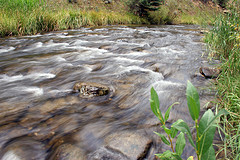
Fresh water stream
Photo credit: makelessnoise
The other day I saw an article about big city water ratings in the United States, and it really got me thinking how sad it is that clean, fresh water is so hard to find. The article was brought to my attention at a good time, as just the other day I watched a program on the History Channel (I think) that spoke of the deterioration of the public infrastructure here in this country. This show was more broad in its content than just public water, but in addition to describing how the public water infrastructure is badly in need of repair, it also described roads, bridges and highway systems that are also in need of repair and in some cases close to failing.

In the article, San Diego -my current city of residence- was ranked 91 out of 100 in terms of water quality. There were 31 different pollutants found in the water since 2004, and 17 chemicals which exceeded health guidelines. This story is not new, as there are always cases of poor water quality surfacing around the country, as well as around the world.

But the thing that strikes me is just how apathetic people are about this. Good, clean water is the one thing that every single person absolutely needs for survival, and it seems that there is barely a place on Earth where the water has not yet somehow been tainted. People look around and see that two thirds of the planet is made up of water, so they see that there is no problem. And if you tell them that it is mostly all polluted, they just assume that modern technology can solve the problems. But it doesn't seem to strike them as outrageous that in just a few hundred years of industry, we have managed to create a problem of epic proportion.

Sure, here in the US we are lucky that we get moderately clean water that comes out of our tap, and yes, there are some remote places in the country left where the water is clean and potable. But those places are getting more and more scarce. And when we have to start questioning the safety of our public water infrastructure as well, it certainly doesn't paint a pleasant picture.

I mentioned that people think modern technology can solve these problems of deteriorating water quality, and to some extent it can. We can take toilet water and turn it to tap water, we can desalinate the ocean and make it fresh, but let me say, as someone who grew up drinking well water from 400 feet beneath my house, there is nothing like a fresh glass of real water that is clean, pure, and tasteless.

Another article I saw the other day described a scenario where there at one time was a small country stream and ecosystem which has subsequently filled in and paved over to build a housing complex. To me, hearing about and seeing these things is sickening. People need to learn before it's too late to they can't just keep destroying these natural systems, and more to the point, we need to start protecting our water sources before it is too late.

Labels: , , , ,

If you liked what you read, please consider subscribing to my RSS feed
For other periodic updates, follow me on Twitter
Did you enjoy this post? Share thoughts in the comments section or using the links below


Reading @russkw Clean water should be taken more seriouslyTweet It     Digg     Stumble     Del.icio.us     Reddit     Buzz     Facebook

0 Comments  |  Links to this post  | Permalink

How to Keep 10,000 Plastic Bags out of Landfills by doing Nothing

Share > Reading @russkw How to Keep 10,000 Plastic Bags out of Landfills by doing NothingTweet     Digg     Stumble     Del.icio.us     Reddit     Buzz     Facebook

I consider myself to be a pretty eco minded person, I wouldn't go so far as too say I'm extreme when it comes to conservation and minimizing waste, but I do exert a fair amount of effort to try to minimize my impact, especially when it comes to over consumption and blatant waste. And I certainly would consider our (Americans) use of plastic a blatant waste.

For my part, I always bring my reusable bags when I go shopping, and I even go so far as to use an empty bread loaf bag to pick up dog poop rather than throw it out unused. These days when I make my lunch I reuse one ziplock bag for several weeks, rather than dispose of it daily, and I also use a tupperware to pack my sandwich and vegetables. Right there, assuming that I make lunch 3 days (and eat out 2) per week, multiplied over 49 weeks (52 minus a measly 3 for vacation), that would ordinarily be 294 bags if I used one for chips or snack, and one for sandwich. But typically I reuse one bag for three or four weeks in a row before it becomes too nasty, and my use of a tupperware removes the need for half of them right away. So that puts me down to only 37 per year for 147 days of lunch. Not great, but a significant reduction from average.

But we all know that you can be the most efficient person in the world, and it's just a drop in the bucket compared to the waste of a business. So I now have a way to save another 245 plastic bags per year by doing nothing. How do I do this? I realized a year or so ago that the cleaning people swap out the bag in the trashcan at my desk if there is anything it.

So the solution? It's simple. I bring my trash to the office kitchen to dispose of it. And just like that, I don't use my trash can and they don't change the bag. (I've experimented to ensure that this is the case.) Just like that 245 bags removed from the landfill.

So above and beyond the hundreds (likely thousands) of plastic bags I save per year by carrying my reusable shopping bags and implementing these simple strategies, I now can include another 500 bags (a low estimate combining lunch and work strategy) that I am saving from our landfills.

If every person made these three simple adjustments, we could save hundreds of thousands (probably millions) of plastic bags from the landfills. Even at a small company of 20 people, these three virtually unnoticeable lifestyle changes would save 10,000 bags from our landfills over one year.

As you can see, making a difference is not that hard.

Labels: , , , , ,

If you liked what you read, please consider subscribing to my RSS feed
For other periodic updates, follow me on Twitter
Did you enjoy this post? Share thoughts in the comments section or using the links below


Reading @russkw How to Keep 10,000 Plastic Bags out of Landfills by doing NothingTweet It     Digg     Stumble     Del.icio.us     Reddit     Buzz     Facebook

0 Comments  |  Links to this post  | Permalink

Organic Deodorant

Share > Reading @russkw Organic DeodorantTweet     Digg     Stumble     Del.icio.us     Reddit     Buzz     Facebook

I have recently found an organic deodorant that finally works. Controls odor well and is aluminum and paraben free. Earth Science Tea Tree Lavender, also see my review of other organic deodorants on the resources page. If you want to see a complete selection of organic deodorants, check out this Amazon page of organic deodorants ... I had no idea that there were so many brands!

*Update 01/15/2009

I have recently been eating mostly raw foods, and believe it or not my body odor is almost completely neutral now. Check out this forum topic. But I still have my Earth Science Tea Tree Lavender as a backup.


*Update 08/05/2008

What does a traditional antiperspirant deodorant do?
It keeps you from perspiring by blocking your sweat glands, and additional makes you smell nice.

What potentially toxic and/or non-earth friendly things are in a traditional deodorant?
Parabens: A preservative that comes in several forms (methyl, ethyl, propyl, benzyl and butyl) and has also been found in breast cancer tumors — though there is no conclusive evidence that it is the cause of said tumors.

Aluminum: A key ingredient in antiperspirant and can be disguised as any of the following: aluminum chlorohydrate, aluminum zirconium tetrachlorohydrex gly or any other aluminum compound. It is an element found in the earth's crust, and bauxite is the ore that is most useful for producing pure aluminum.

Triclosan: A chemical that is classified as a pesticide by the FDA. It’s thought to contain carcinogenic contaminants and is stored in body fat. Also look for triclosan in antibacterial soaps.

Talc: This seemingly benign duster of baby bottoms is often contaminated with asbestos (which is carcinogenic).

Propelyn glycol: As a "penetration enhancer", propelyn glycol is believed to be a neurotoxin that may cause kidney or liver damage.

*Thank you MSN and answers.com

After that, do you need to know the benefits of organic deodorant?

  • Minimizes the need to use aluminum (a natural resource), that may often be mined using slave or cheap labor, which also unnecessarily destroys the earth

  • Minimizes the need to produce toxic chemicals, also keep toxic and potential cancer causing chemicals off of your skin

Labels: , ,

If you liked what you read, please consider subscribing to my RSS feed
For other periodic updates, follow me on Twitter
Did you enjoy this post? Share thoughts in the comments section or using the links below


Reading @russkw Organic DeodorantTweet It     Digg     Stumble     Del.icio.us     Reddit     Buzz     Facebook

0 Comments  |  Links to this post  | Permalink